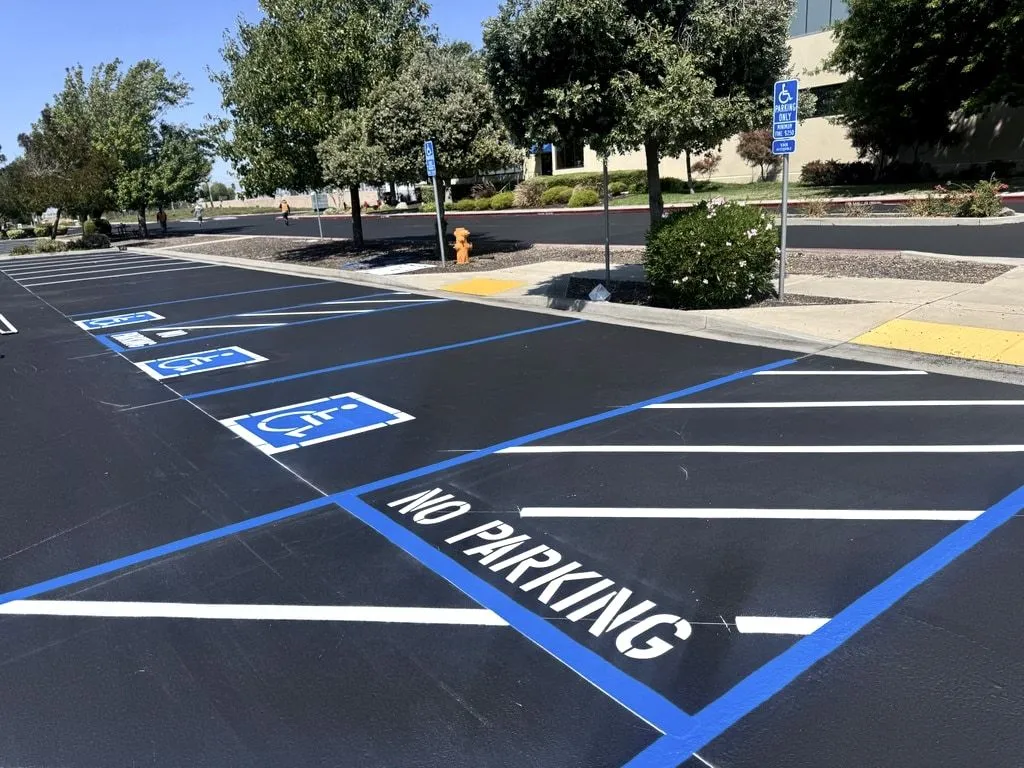
A row of blue-striped accessible stalls with posted signs and a yellow detectable warning pad at the curb ramp.

Markings

Wheel stops, parking signs and bollards

Wheel stops, accessible parking and fire lane signs, and bollards, installed on asphalt or concrete and anchored so they stay put.

In brief

Signage and wheel stops make a striped parking layout work: wheel stops keep vehicles from overhanging walkways, landscaping and accessible routes, and signs mark accessible stalls, fire lanes and tow-away zones. Stops are installed on asphalt and concrete and fixed so they do not work loose; post-tensioned slabs are not drilled blind. Broken units can be replaced on their own.

On this page
  1. 01Wheel stops
    1. What wheel stops do
    2. Concrete, rubber and recycled plastic wheel stops
    3. Wheel stop placement and anchoring
    4. Replacing damaged wheel stops
  2. 02Signs, posts and bollards
    1. Parking lot signs and ADA signs
    2. Sign posts and bollards
  3. 03Planning and cost
    1. What affects the cost of wheel stops and signs

01

Wheel stops

What wheel stops do

Wheel stops, also called parking stops, parking bumpers or car stops, keep vehicles from overhanging walkways, landscaping and neighboring stalls. Where a walkway at the head of a stall is part of an accessible route, they keep its clear width open. They go on both asphalt and concrete.
Concrete, rubber and recycled plastic wheel stops

Precast concrete is the most common choice on commercial lots, but rubber and plastic stops suit some sites better.

  • Concrete. Durable and economical, but heavy, and the ends can chip.
  • Rubber. Light and resists chipping, but relies fully on its anchors.
  • Recycled plastic. Light, colored through and easy to replace.
  • Low-profile. Rubber or plastic stops for vehicles with low front ends.

Wheel stop placement and anchoring

Stops are centered in the stall, set far enough back that the bumper stops short of the curb or walkway, and lined up across the row. They shouldn't sit in access aisles, walking paths or drainage paths.

On asphalt, they are pinned through the stop into the pavement and base. On concrete, they are drilled and pinned, anchored or glued. Post-tensioned slabs and parking decks aren't drilled without knowing what's inside, so adhesive mounting is often the better choice there.

Replacing damaged wheel stops

Concrete stops break at the ends and then crack through; rubber and plastic stops shift or lose their anchors. Either way, a damaged stop becomes a trip hazard. The old unit and pins are removed, the new stop is set in line with the row, and the pavement underneath is patched if it has failed. It's a common standalone job, and fits well with restriping.

02

Signs, posts and bollards

Parking lot signs and ADA signs

Standard traffic signs like STOP and one-way follow the California traffic control manual. Each accessible stall needs a sign with the symbol of accessibility, mounted with its bottom at least 60 inches above the ground, and California adds tow-away signage at each lot entrance or beside the accessible stalls. Missing or wrong accessible parking signs are a common violation, and one of the simplest to fix.

  • Accessible parking and van-accessible signs
  • Tow-away and fire lane signs
  • STOP, one-way and speed signs
  • Reserved, visitor and EV charging signs

Sign posts and bollards

Posts are set in concrete footings or surface-mounted where the slab allows, after underground utilities have been located through USA North 811. Bollards protect entrances, meters, EV chargers and walkways that a curb or wheel stop can't. They can be fixed in footings, surface-mounted, removable or flexible.

03

Planning and cost

What affects the cost of wheel stops and signs

We price hardware by count and condition. After resurfacing or seal coat, we put wheel stops and signs back to the approved layout, not roughly where they were.

  • Number of wheel stops and the material chosen
  • Surface type, and whether drilling is restricted
  • Removal of damaged units and old pins
  • Number and type of signs, posts, footings and bollards
  • Whether the work is combined with restriping or seal coat

Specification

How we build it

The details that decide service life, stated plainly so they can be compared against any other proposal you receive.

Wheel stops
Installed on asphalt and concrete, fixed so they do not work loose.
Anchoring
Pinned into asphalt; pinned, anchored or adhered on concrete.
Post-tensioned slabs
Not drilled blind; adhesive mounting where drilling is not appropriate.
Accessible signage
Content, dimensions and mounting height to the required detail.
Sign posts
Set in concrete footings or surface-mounted, after utility locating.

Questions

Signage & Wheel Stops FAQs

Do wheel stops go on asphalt as well as concrete?

Yes. The fixing method is different, but both are routine work for us.

Are wheel stops required?

Not everywhere, but they're often needed where a stall meets a walkway, landscaping or an accessible route, to keep vehicles from overhanging it.

Can you replace just the broken wheel stops?

Yes. Replacing damaged units is a common standalone job, often combined with restriping.

How far from the curb should a wheel stop be installed?

Far enough that the bumper stops short of the curb or walkway. The right distance depends on the vehicles and what's beyond the stall, and many cities publish a standard detail.

How high should parking lot signs be?

Accessible parking signs are mounted with the bottom of the sign at least 60 inches above the ground. Other signs vary by type and jurisdiction.

Get started

Need wheel stops, parking signs and bollards?

Send the property address and what you are seeing. An estimator will walk the site and tell you whether this is the right scope before quoting it.