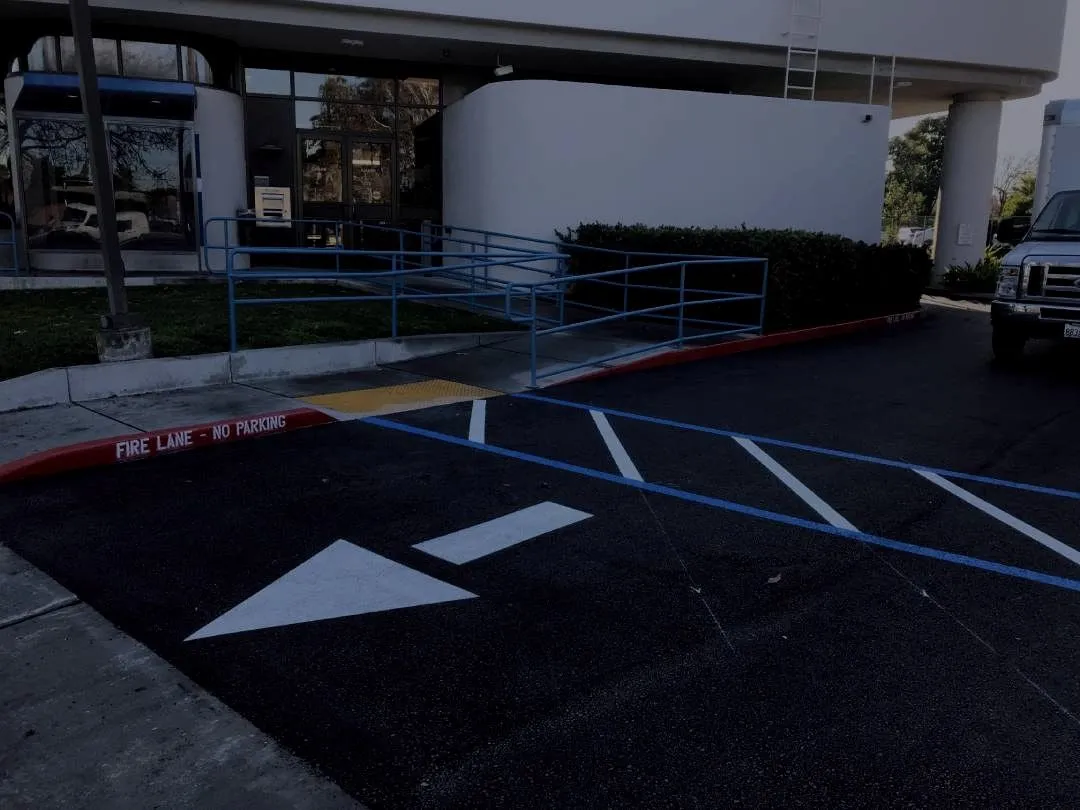
A freshly paved and restriped commercial lot with a new ADA ramp, detectable warning pad and red fire lane curb.

Service area · Santa Clara County

Commercial asphalt paving in San Jose, CA

The largest city in our service area, where the paving moratorium and the encroachment permit shape the schedule as much as the square footage does.

San Jose is the biggest city we work in and the southern anchor of our service area. We are members of BOMA Silicon Valley, whose own office is on West San Carlos Street, and Santa Clara County is one of the eight counties we have worked in since 2015.

Most South Bay work is private property: office and R&D campus parking, retail centers, apartment communities and industrial yards. When a job does touch the public right-of-way, San Jose has its own rules, and they are worth knowing before a schedule is promised rather than after.

On the ground

What pavement work in San Jose actually involves

Local conditions, not a template with the place name swapped in.

The paving moratorium is the first thing to check

San Jose restricts digging in streets that have recently been resurfaced or reconstructed, and it publishes an interactive moratorium map so you can check a street before you plan work on it. If your frontage is inside the window, an ordinary trench or utility cut stops being ordinary.

Worth knowing: the city's own published figures for how long the moratorium runs do not agree. The transportation department's moratorium page gives two years, while the city's open data portal describes the Paving Moratorium Streets layer as three. That is a good reason to check the specific street rather than assume a number, which is what we do before pricing any work in the right-of-way.

Breaking a moratorium is not automatically refused, but it usually triggers superior restoration under the city's Council Policy 8-6, meaning you repave far more than the trench you opened. Development and emergency work can be treated differently. Either way the cost belongs in the estimate at the start, not in a change order.

Right-of-way work needs a permit before it needs a crew

Work affecting the public right-of-way in San Jose requires a permit from the City, under Chapter 13.36 of the municipal code. Encroachment permits are handled through Public Works, and the lead time is part of your schedule whether or not anyone planned for it.

This is the same discipline we bring to downtown Oakland, where we ground and repaved four city streets at 226 13th Street to City of Oakland DOT requirements while keeping public access open throughout. The agency changes; the habit of sorting the permit and the phasing before mobilizing does not.

Campus and R&D parking, where the lot is the front door

A great deal of San Jose's commercial building stock is office and R&D campus, and on those sites the parking field is large, busy on weekdays and effectively the building's entrance. Shutting all of it is not an option, so the work gets phased around the working week, and sometimes into nights and weekends.

That is the same problem as a shopping center that cannot close. At Rancho Cotati we took a 112,800 SF retail field in sections and handed each one back as it was finished, resurfacing the whole lot in eight days with the center open the entire time.

Campus lots also tend to carry the accessibility exposure. ADA improvements, stall slopes, access aisles and path of travel are worth scoping alongside the paving rather than as a second project a year later.

A longer, hotter working season than the coast

The South Bay runs warmer and drier through the summer than Oakland or San Francisco, which lengthens the practical window for sealcoating and surface work at the ends of the season. It also means hot-weather days where the mat has to be rolled promptly and sealcoat can flash off faster than anyone wants.

The useful consequence for an owner is scheduling freedom: South Bay work can often be booked earlier in spring and later in autumn than the same job on the coast, which matters when a board or an asset manager is trying to land a project inside a budget year.

Questions

Working in San Jose

Do you work in San Jose?

Yes. Santa Clara County is one of the eight Bay Area counties we have worked in since 2015, and San Jose is the largest city in that footprint. We are also members of BOMA Silicon Valley.

How do I know if my street is under the San Jose paving moratorium?

The city publishes an interactive moratorium map covering streets with recent pavement work. Check the specific street rather than relying on a general rule: the city's own pages quote different windows, two years on the transportation department's moratorium page and three on the open data portal.

What happens if work has to break the moratorium?

It is usually allowed but comes with superior restoration requirements under Council Policy 8-6, which means repaving well beyond the cut itself. Development-related and emergency work can be handled differently. We price that restoration up front rather than discovering it later.

Do I need a permit for paving work in San Jose?

For work affecting the public right-of-way, yes, under Chapter 13.36 of the municipal code, through an encroachment permit from Public Works. Work entirely on private property, which is most parking lot work, generally does not, though accessibility and drainage requirements still apply.

Can you work nights or weekends on an occupied campus?

Yes. Phasing around an occupied site is the normal condition for us, not an exception. We agree the phasing, access routes and notice before mobilization and build it into the price.

Every project in San Jose is run from Forticon's office at 1300 Clay Street, Suite 600, Oakland, CA 94612 · (510) 328-3230

Get started

Have a property in San Jose?

Send the address and what you are seeing. An estimator will walk the site and tell you what is actually failing before quoting anything.