Pavement Maintenance
Asphalt Seal Coating FAQ for Property Managers in Oakland & the Bay Area
The practical seal coating questions we hear on nearly every walk-through of a commercial lot: getting it ready, keeping it open, working around the weather and comparing bids.
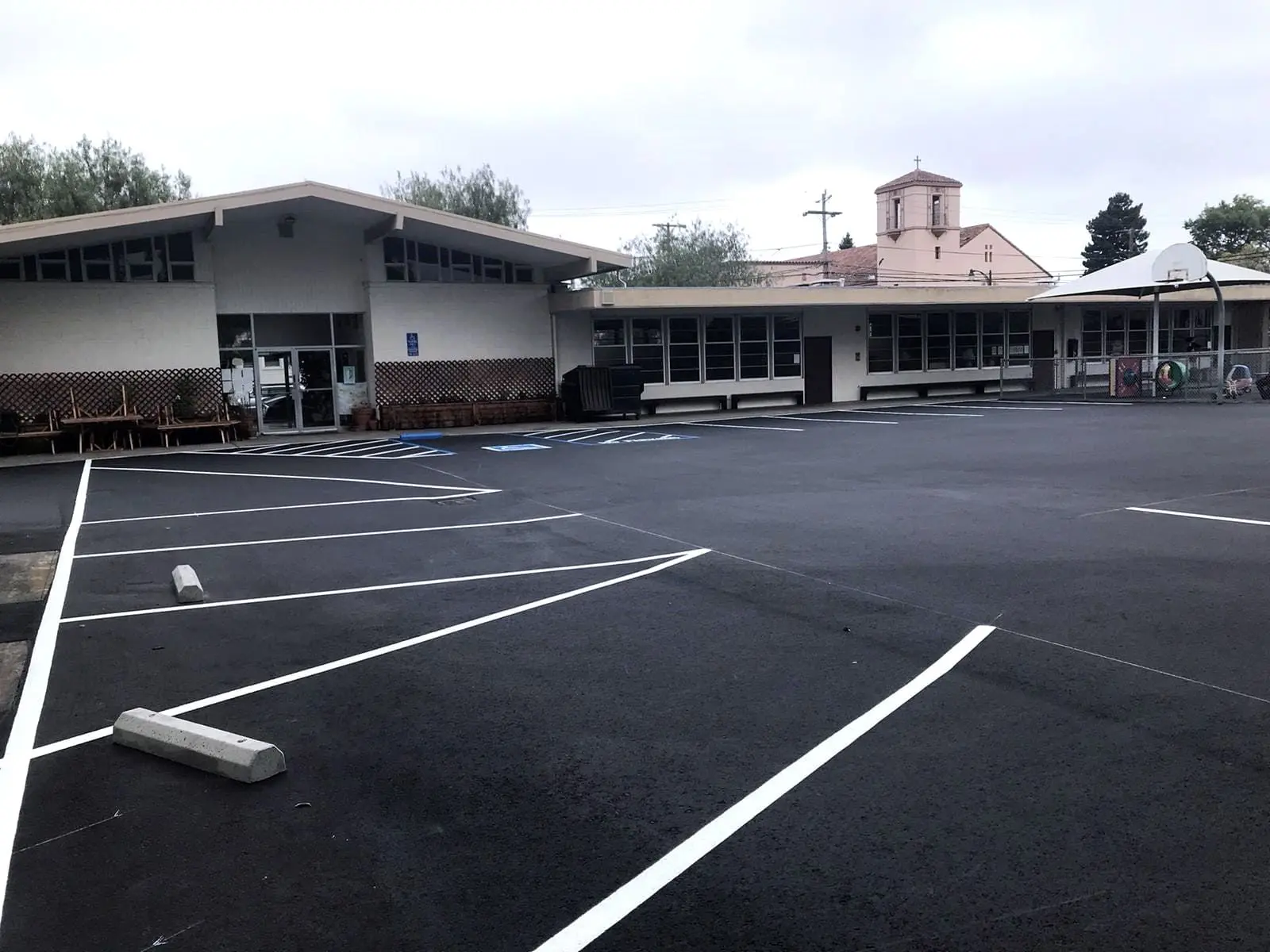
These are the practical questions we hear on nearly every walk-through of a commercial property in Oakland and around the Bay Area: getting the lot ready, keeping it open, working around the weather and comparing bids. For what seal coat does, how often a lot needs it and when it isn’t the right fix, see our sealcoating service page.
1. How do I know whether my lot is ready for it?
Start with the color. Asphalt begins deep black and fades toward gray as the binder oxidizes. A gray lot is telling you the binder is hardening.
Then check whether your lot is a good candidate. Walk the drive aisles and look for connected cracking in a pattern like alligator hide, areas that feel soft or move under a loaded vehicle, or dark staining around cracks after rain. Any of those means the base is involved, and the right fix is repair, not a coating.
The short version: gray but sound is when seal coating pays off.
2. What has to happen before the coating goes on?
These steps go in this order, and the order matters:
- Sweep and clean. Coating bonds to pavement, not to dirt.
- Treat oil spots. Oil-stained asphalt is degreased and primed, or the coating won’t stick there.
- Repair failures. Cutting out a failed area after sealing means sealing it again.
- Seal cracks. Sealant goes into cleaned cracks on dry pavement. See crack sealing.
- Then coat.
- Then restripe.
If a proposal goes straight from “sweep” to “coat” on a lot with visible cracks, you’re paying for a season of good looks, not real maintenance.
3. Why does my lot need crack sealing separately?
Because seal coat can’t bridge a crack. It’s about as thick as a few sheets of paper, so it flows into the crack and disappears, leaving the crack just as open as before.
Cracks matter more than the surface does. A crack is a direct path for water into the aggregate base. A soaked base can’t carry the load, traffic works the soft spot, and what started as a hairline crack becomes a pothole and then a full-depth repair. Crack sealing often gets put off simply because a crack doesn’t look urgent, which is exactly how it ends up costing the most.
4. How long will the lot be out of service?
Plan on 24 hours before traffic goes back on a coated area, and longer in cool or damp weather. Striping goes down after the coating has cured, which adds its own short window.
For properties that can’t close, and most can’t, we phase the work to keep disruption to a minimum. The lot is divided into sections, each one is closed for its cure window and reopened before the next one starts, and access, fire lanes and accessible stalls stay open throughout. It takes a little longer overall, and it keeps your tenants, employees and customers moving. Our project manager will plan the schedule directly with you.
5. What is the weather window?
Seal coating should be done on warm, dry pavement, with temperatures above 50°F and a dry window after application. In most of the Bay Area that means late spring through early fall. It also means keeping an eye on the marine layer as well as the forecast. A lot in Brisbane or San Francisco can stay damp into the late morning when an inland lot in Concord has been dry for hours.
Rain on uncured seal coat means redoing the work, not just waiting. That’s why our crews will hold off on a day that looks fine at 7am if conditions aren’t right.
6. Why are two bids for the same lot so far apart?
Square footage usually isn’t what explains the difference. The scope is:
- Preparation. Sweeping, oil spot priming, crack sealing and patching can cost more than the coating itself on a neglected lot.
- Number of coats. Two coats on drive aisles and one on parking stalls is a common, sensible approach. A single coat everywhere costs less and wears out sooner.
- Production and phasing. Obstacles, tenants, traffic control and the number of phases all affect how much gets done in a day. A lot that has to stay open costs more to seal than an empty one, because the crew sets up more than once.
- Striping scope. Repainting the existing layout is one number. Re-laying out stalls, or bringing accessible parking up to current code, is another.
7. What should a proposal tell me?
A proposal you can compare should include, at a minimum:
- The measured area being treated, not an estimate from an aerial photo
- Whether cracks are being sealed, and how many linear feet
- What patching is included, and where
- How many coats, and where each one goes
- The striping scope, including whether accessible stalls are being corrected
- The phasing plan, and what stays open when
- What is specifically excluded
If a proposal is a single line and a single number, there’s no way to know what you’re buying. That isn’t really a pricing problem. It’s a scope problem, and it tends to turn into a disagreement on site later. Ours spell all of it out.
If you have a property in the Bay Area and want to know whether it’s a good candidate for seal coating, contact us for a free estimate. We’ll walk the lot with you and lay out your options. If seal coating isn’t the right answer yet, we’ll tell you that too.
Questions
Common questions
What is the best time of year to seal coat in the Bay Area?
Late spring through early fall. Seal coat needs warm, dry pavement and a dry window after application, and the coastal Bay Area adds fog and the marine layer to the usual temperature question. We generally schedule work when the surface is above roughly 50°F and warming, with no rain forecast for at least 24 hours.
Why do two contractors quote such different numbers for the same lot?
Usually because they aren't quoting the same work. One price may be a single coat over the lot as it stands, while the other includes sweeping, oil spot priming, crack sealing, patching and two coats on the drive aisles. Compare the scope line by line before you compare the totals.
Does seal coating make a lot slippery?
A properly specified commercial seal coat includes sand or aggregate in the mix, which gives the finished surface texture and grip. A coating applied without it can be slick when wet, which is one reason the specification matters as much as the product.
Can you seal coat one section at a time?
Yes, and on any property that can't close, that's how we normally do it. We divide the lot into phases so parking and access stay available the whole time, with each phase closed for its cure window and reopened before the next one starts.
About the author
Forticon Project Team
Estimating & Project Management, Forticon, Inc.
Forticon’s estimators and project managers, who scope, price and run commercial pavement work across eight Bay Area counties.
Related services
- Sealcoating Seal coating protects sound asphalt from sun, water and oil, and evens out the color of a patched, faded lot.
- Crack Sealing Sealing cracks keeps water out of the base, before a small crack turns into a pothole or a failed area.
- Parking Lot Striping Layout, restriping, stencils, red curb, accessible stalls and thermoplastic for parking lots, apartment and HOA communities, business parks and city streets.